We may receive a commission when you use our affiliate links. However, this does not impact our recommendations.

For me, the goal with my smoothing plane is to set it up so I can ignore the grain direction of a board or a glued-up panel.
There are many valid ways to do this. For most woodworkers I know, there are two ways to accomplish this goal that we all agree upon:
- Sharpen the iron. Sharp fixes almost everything.
- Take a finer cut. Thin shavings reduce tear-out.
After using those two strategies, woodworkers differ on what else we can do to reduce tearing. We fall into three camps:
- Use a high angle of attack. The higher the planing angle, the better – 62° or so being the maximum planing angle before you start delving into scraping.
- Reduce the mouth aperture. The finer the mouth, the less likely the cut will shift so it is occurring ahead of the iron’s cutting edge. Reduce the aperture to reduce tearing.
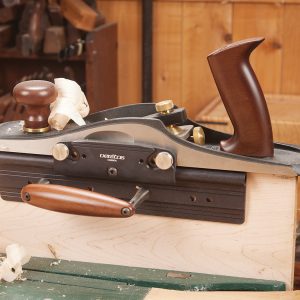
- Use a “back iron” or “chipbreaker” that is set about .004” to .008” back from the cutting edge.
I will swear on a stack of Joseph Moxons that all three strategies work. You simply need to pick one that suits you best. Using all three simultaneously, however, will cause your handplane to clog.
During the last few years I have used a back iron with great success after I figured out a few of the details that make it effective. The above video shows the steps I take with a new back iron to make it effective. Though I hate to repeat the points of the video, here are the important points:
- Sharpen the iron. Sharp. Sharp. Sharp.
- Sharpen the tip of your back iron so it has a 50° bevel at its tip. Some back irons have a small flat at the tip that will cause your plane to clog. Sharpening the tip of the back iron removes this small flat and helps eject shavings. You have to do this once every few years or so – not every time you sharpen.
- To prevent shavings from getting between the back iron and iron, turn a hook on the tip of the back iron – much like you would turn a hook on a scraper. This hook will eliminate most gaps between the back iron and iron, reducing clogging. It takes about 10 seconds to add the hook right before you screw the back iron to the iron.
- Set the cap iron about .004” to .008” from the cutting edge.
Woodworkers who dislike back irons will tell you that these strategies are difficult or time-consuming. Try them out before you agree or disagree.
Using a back iron can be an interesting experience. When set properly, the back iron will push the shavings out smoothly without making the plane difficult to push. But when set poorly or when the back iron has a flat on its tip, the plane can be quite difficult to push.
The tool will still reduce tearing in this configuration, but I have found that the surface quality will suffer a bit, though not any worse than with a card scraper.
I’ll be honest: I like all three strategies for reducing tear-out and have employed them all successfully during the last 19 years of working with handplanes. I encourage you to try them all, and refuse to let anyone tell you there is only one magic trick to eliminating tear-out.
— Christopher Schwarz
Here are some supplies and tools we find essential in our everyday work around the shop. We may receive a commission from sales referred by our links; however, we have carefully selected these products for their usefulness and quality.