We may receive a commission when you use our affiliate links. However, this does not impact our recommendations.

We’ve been testing six carcase saws for the Autumn 2009 issue of Woodworking Magazine. And while I can’t share the results of the test with you just yet, I want to share some of the interesting stuff we dug up that didn’t fit in the printed edition.
My goal was to answer the simple question: Should carcase saws be filed for ripping or crosscutting? I’m not sure I even accomplished that. So let’s take a look.

The carcase saw from Joseph Smith’s “Key.”
The term “carcase saw” is one that appears fairly early in the literature of English woodworking. Though Joseph Moxon doesn’t mention it in 1678, tool inventories in the late 18th and early 19th centuries mention it by name. And the earliest illustrated woodworking catalog I have , “Explanation or Key to the Various Manufactories of Sheffield” , says carcase saws are 12″-long open-handed saws that are available with iron, steel or brass backs.
But not much is ever said about the teeth of the tool. And that’s frustrating because the teeth tell the story of what the saw was used for.
Benjamin Seaton’s carcase saw (a well-preserved early 1800s example) is a 14-point saw and has a handle that is angled like his dovetail saw. But we don’t know how much rake was on the teeth when the saw was made or if there was any fleam.
(Rake is how much the teeth lean back from the perpendicular, which controls how aggressive the saw is. Fleam is the bevel on the front of each tooth. It controls how smoothly the saw cuts, plus how fast it is.)
The question of fleam on a carcase saw is a significant one. Add enough fleam and the saw is optimized for crosscutting only. Some (but not all) scholars contend that there is no evidence that early woodworkers used significant amounts of fleam on their saws , which is why all the saws at Williamsburg are filed with a ripping tooth.
So how did early woodworkers crosscut, according to the scholars? With rip saws. You can crosscut or rip with a rip saw. You just have to take care or extra steps to ensure the cut is clean.

Teeth with fleam (at top) and without (below).
By the middle of the 19th century, fleam was everywhere. All the major writers of the time comment on it and it is available on many saws. Charles Holtzapffel’s seminal work on the craft has a fantastic chart of all the saws available for woodworking (download it here). He lists the carcase saw as being 10″ to 14″ long, having 12 ppi and a form of tooth that could be crosscut or rip.
Modern carcase saws are typically filed crosscut, though rip versions are available from some makers.
But none of this answers the question: What are they used for?
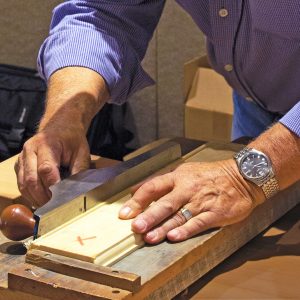
The name “carcase” implies that they are used for cuts in casework, but that can be anything. I have always used a crosscut-filed carcase saw for trimming rails, stiles and boards 6″ wide or narrower to length. Plus all manner of notching, cutting pins and muntins to length, and removing waste to install locksets. I usually use my carcase saw with a bench hook (as shown in the magazine pages atop this entry).
But what if the carcase saw is supposed to be filed rip?
Adam Cherubini, the writer of Popular Woodworking‘s Arts & Mysteries column, and I got into an e-mail chat about this topic.
“I always thought of carcase saws as the dovetail saw used to saw out the larger dovetails on carcases,” he writes. “London drawer components got thinner and thinner as the 18th century wore on. At its dawn, drawer sides were often quite thick as side-hung drawer runners were used. When that design was put aside, early in the century, drawers got substantially thinner.
“London drawer sides got down to about 3/8″ thick with big drawers and were as small as 3/16” for little drawers. Most folks point to a lumber shortage in London as the cause, but I find thinner stock significantly easier to deal with.
“It could be that ease of use and reduced cost of sawing associated with mechanized lumber mills or just improved saws (steel!) and business practices made thin stock preferable. The drawer stock thickness of course affected the sort of saw required. Thin stock really requires fine teeth while the 7/8” carcase sides were better done with another.
“I don’t think the name (carcase saw) means much to modern woodworkers. But it should. For if a carcase saw is designed for cutting carcase dovetails, it should be optimized for its purpose with nicely raked rip teeth and a long narrow (and thin) blade. I think some sawmakers are hanging too much steel under their spines for these saws.”
To me, this implies we should continue to call the smallest backsaw a dovetail saw and rename the carcase saw as the condortail saw.
It sounds like I need to start using a rip carcase saw , sorry, condortail saw , for carcase dovetails and see how it works.
– Christopher Schwarz