We may receive a commission when you use our affiliate links. However, this does not impact our recommendations.
 Woodworking really is simple, despite all attempts to complicate it. Complications introduced by well-meaning folks can keep a beginner away from the enjoyable part: making things. One of the most common questions is “what tools do I need to get started?” and as the would-be woodworker starts reading he soon begins asking, “Which set of these? How many of those?” The worst thing that can happen is he or she decides to wait until all the tools are in place before making a start. The truth is, one sharp tool and a hunk of wood will take you farther, faster.
The big myth in woodworking is that there is a magic tool that will make a difficult task easy, or that the right assortment of tools will deliver mastery of the craft. There is some truth to that, but it is easily exploited, both by sellers of tools and writers in need of a topic. The problem is that without experience, a beginner really isn’t able to tell the often-subtle difference between specialized tools. If you get one chisel, one saw, or one plane and put it to work, you’ll begin to understand the relationship between your eyes, brain, hands, sharp steel and wood. When you develop that understanding, the next tool to get becomes obvious.
 If you start with a bunch of saws for example, the chances are good that your skills and knowledge won’t develop. It’s too easy to assume it’s the tool and not the user, and reach for the next one. If you only have one saw, the fundamentals of hand/eye coordination, staying on the line, keeping the thing plumb and starting a cut will develop. When you can get a saw to cut, you’ll find yourself in situations where the teeth are too fine (or too coarse), or the size isn’t appropriate to the work, or the sharpening isn’t optimal for the direction you want to go. Your experience, and your level of satisfaction with what you have will point you in the right direction.
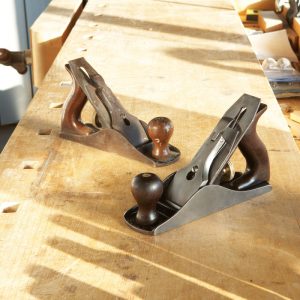
Eventually, you’ll end up with a bunch of tools. You’ll have chisels for dovetailing, other chisels for mortising, a few cherished ones that only do one thing (but do it extremely well) and a couple of cheap ones that aren’t good for anything but opening paint cans or scraping up gum. You’ll have planes that work wonders for some tasks and suck at others. A few planes will do most of the work – others will only touch wood on special occasions. There is a natural progression that works well, but only if it is driven by an understanding based on experience.
You can benefit from someone else’s experience, but that only goes so far. Without experience of your own, you can acquire a bunch of stuff without really knowing why. Too much stuff too soon will get in the way of learning skills and you’ll never understand why the Starrett 9” adjustable square and the 5-1/4″ junior jack plane are absolutely essential.
These products are also fantastic resources for the beginner woodworker:
“Tool Basics for Getting Started in Woodworking” DVD, with Megan Fitzpatrick.
“Getting Started with Routers” DVD, with David Thiel.