We may receive a commission when you use our affiliate links. However, this does not impact our recommendations.
 One of the sure signs of getting old is finding out that the kid who works in the next cubicle never heard of the TV show “WKRP in Cincinnati.” Another sign is remembering something that is taken for granted today was at one time brand spanking new. Our web guy wasn’t even born in 1982 when “WKRP” was canceled, but it was about that time that I ponied up $300 to put a Biesemeyer fence on a hand-me-down Delta contractor’s saw. Until then, setting the fence on a table saw was one of the things that gave cabinetmakers the reputation for being fussy and fiddly. My new fence improved my productivity and my accuracy in ways I couldn’t imagine. But part of installing the fence also changed the way I looked at accuracy – the section of the manual that recommended calibrating the fence by using a pair of calipers to measure the results of the cut.
I didn’t own any calipers at the time, so I tried to use every other measuring device I own. After a wasted afternoon producing a bunch of sticks that were almost 2″ wide, I went and bought a pair of fractional dial calipers. That decision was as big a boost to my skill set as buying the fence.
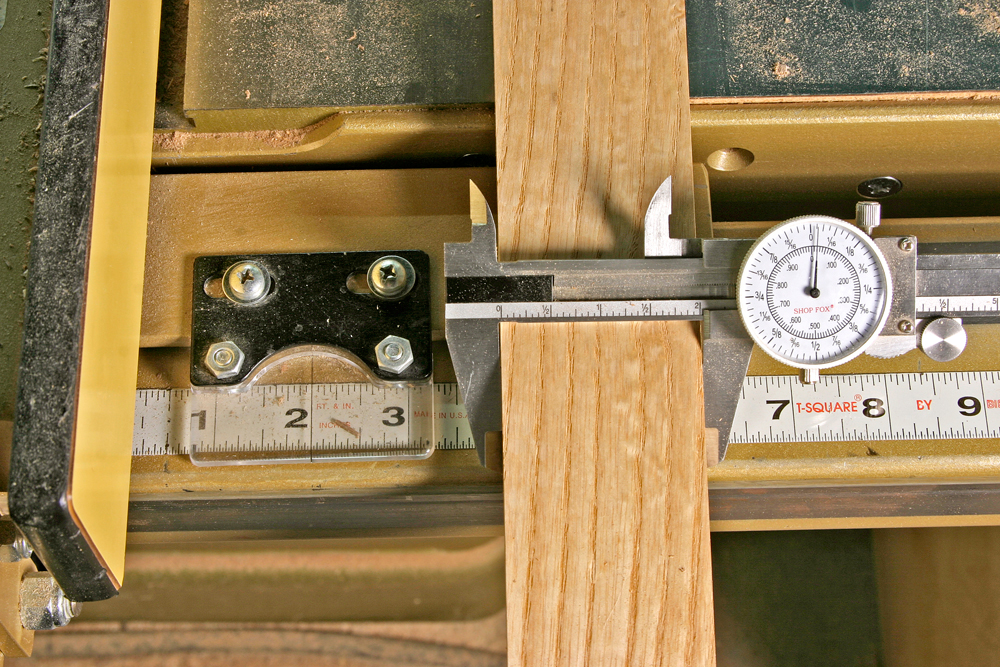
Calibrating the fence is a simple process. Set the indicator to 2″ and cut a piece of wood. Measure that piece of wood with the calipers, then readjust the scale to the dimension on the caliper. Reset the fence to 2″ and try again. When the numbers agree, you have an accurate and reliable scale on your saw. In the photo (you can click on it to make it larger), the fence setting is 1/64″ over.
 I know that several readers at this point are saying, “wait a minute that’s pretty close, certainly close enough for woodworking.” I’m a complete slob in the shop in many ways, but I am convinced that the tolerances for good work are much closer than 1/64″. Try fitting a tenon that is 1/64″ too big into a mortise. You don’t have a hammer big enough. Put a tenon that’s 1/64″ under-size in that mortise and it falls right out. If you make the choice to work to close tolerances, you need to think about the tools and methods you use and the thinking that goes along with your choice. The benefit is you no longer have to work by guessing.
Here’s what the scale looks like after adjusting. Again, you might want to click on the image to make it larger. The scale only reads to 1/32″, but if you look carefully you can work to twice that resolution by placing the cross hair in between the lines. You may have to turn on some extra lights, get your reading glasses, close one eye and position your eye directly over the scale. That sounds like a hassle, but it’s worth it.
Having an accurate saw (and a way to measure) led to several things for me. I went through my tool inventory and got rid of or fixed all the squares, tapes and rules that weren’t right on the money. When the tools were set, I had to adopt some standards for how I measured. For the most part, that involved using the right tool for the task, and using it the right way.
 In this photo, I’m using an extremely nice 6″ rule to measure the thickness of this board, but I’m making some fundamental mistakes. If my tool-and-die maker grandfather were still around he would chew on me for about half an hour regarding my technique. What’s wrong with this picture? I don’t have a good point to measure from. I lined up the end of the ruler with one edge of the board with my thumb, and I shifted my hand a little bit right after that. Is this hunk of wood 7/8″ as the number at the top suggests, or is it 1/32″ smaller as the number at the bottom is telling me? My reading would be far more precise if I took another piece of scrap, held it to the edge of the board and placed the end of the rule against that.
 Better yet is to pick up the calipers. With a jaw on each side there isn’t any guesswork about where I’m measuring from or where I’m measuring to. With the rule I wasn’t quite sure what I had, and it turns out that both of my guesses were wrong – one too high and one too low.
It doesn’t always matter if you hit the number you were aiming for. If this piece didn’t need to fit into something, or match something, it’s every bit as good as a piece that’s really 7/8″ thick. But there are plenty of times that it matters a lot. And if you don’t know exactly what you have, you’ll end up guessing about what’s important and what isn’t too.