We may receive a commission when you use our affiliate links. However, this does not impact our recommendations.
I try to be helpful when readers have a question, but there is one question I’m often asked that I usually refuse to answer. The question relates to some project or drawing I’ve published, where I’ve used an angle other than 90 degrees. The reader wants to know why I omitted specifying the angle in degrees. The reason I don’t want to answer is that I truly want to be helpful, and most of the time knowing the degrees of the angle in question won’t help a bit if you’re trying to make the thing. The other reason I’m reluctant to answer is that I don’t know. It’s a rare occasion when the degree of an angle enters my thinking. Take for example the Morris chair I recently completed. The lower side rail drops 3/4″ over a 21-7/8″ length. To find the angle to cut the shoulders, I draw the parts full-size and set my adjustable bevel to the drawing. If I really want the number, I can draw the parts in AutoCAD and measure the angle. The number, by the way is 1.959 degrees, and the problem is that we don’t have anything in our shop capable of measuring angles that precisely.

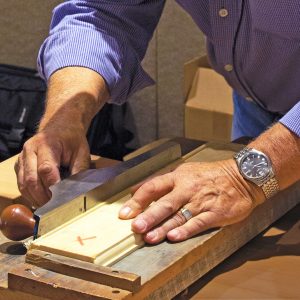
Angles are the great paradox of woodworking. If you’re off even a tiny amount, joints won’t close. But measuring angles with a protractor is more difficult than you might think. And if you try to go by degrees, measuring, marking and transferring are all good opportunities to get further away from where you want to be. For me making a drawing or using a compass to bisect an odd angle gives me points that I can connect with a line, and I can cut (and trim) to a line. In the image above, four pieces 12″ long are mitered at 45.1 degrees, and this is the other problem inherent in angled cuts. A seemingly tiny error at each corner is multiplied as you go around the frame, and the gap at the end is 1/8″. That one-tenth of a degree, by the way is the accuracy and resolution claimed by a current crop of digital angle gauges. What sounds good on the catalog page leaves a gap you can drive a truck through. The methods I use have evolved over centuries of woodworking, but I know my advice to eschew numbers leaves many woodworkers cold. If you want the numbers, there is a new tool that will give them to you.

I’ve spent the last few days using a prototype of the AngleMaster Pro v2 from Bridge City Toolworks. As with all Bridge City tools, the workmanship and machining is flawless, and the results are impressive. Here’s the short version of how it works: The numbers displayed are a representation of the length of the hypotenuse of a triangle. Minute changes in the position of the outer legs change the length shown in the display, reading in 1/100s of millimeters. After taking a reading, you need to translate that number to an angle. At the risk of sounding trendy and trite, there is an app for that.

You can solve just about any type of angle problem by entering the numbers you know. You can find precise angle settings for mitering pieces of different widths, and you can get the compound angle settings for multi-sided tapering boxes. Enter an angle and it will give you the caliper setting. Enter the caliper setting and it will give you the angle. Enter rise and run and it will give you both. It calculates angles for segmented rings, and will give you the circumference of a circle. John Economaki’s blog goes into great detail about how the tool and the app work, and it’s worth a read.
In use, it worked well but it took me a while to get used to the incredibly small increments being measured. There are some accessory shoes that will make this easier to use in some settings and situations. Of course, this kind of precision device doesn’t come cheap, but if you’re after this level of work you’ll consider it a good value.

The company plans to make these tools in once a year runs. Pre-production orders will open soon at a price of $289, without the digital caliper, for delivery in June. Obviously this is not a tool everyone will want or need, but it represents an important development not only in how we measure our work, but in how we think about it. Precise methods are often scoffed at in the woodworking community, but the dynamic nature of the material we work with isn’t an excuse for sloppy work. We may take different roads to get where we want to be, but joints that really fit are the goal, whether we prefer to work by the numbers or by eye. If you’re a numbers guy, you should take a closer look at this tool.