We may receive a commission when you use our affiliate links. However, this does not impact our recommendations.

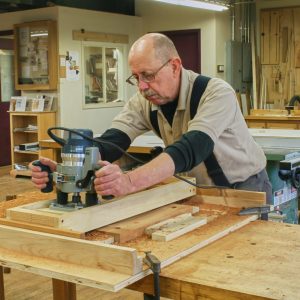
Our magazine’s workshop is an odd duck. In some ways it’s equipped better than some commercial shops (with our eleventy-billion new routers) I’ve been in, but it lacks sorely in other ways (no spray booth). While we have a wide variety of tools that pass through our hands for testing (many of which never get written about , we’re picky) we also have a core set of machines that almost never gets changed.
Since the day I walked in the door here, we’ve had the same Powermatic 66 cabinet saw. We’ve changed lots of things about the saw, mostly relating to its crosscutting functions, but the only real maintenance we’ve ever had to perform on it is cleaning the worm gears and replacing the arbor bearing and assembly late last year.
We’ve had a couple powered jointers, but for the last five or six years, we’ve had a Bridgewood 12″ jointer. A couple years ago, one of the other editors and I disassembled the jointer and installed an aftermarket spiral carbide cutterhead. It was a nightmare operation, really, but the machine is now working quite well, except the dang fence. The fence doesn’t want to seem to hold at 90Ã?° to the table. I’ve been tweaking it these last couple weeks (maintenance never ends), and I think I’m closing in on a solution.
We’ve had three power planers , right now we have a Yorkcraft 20″ model. All of the machines are connected to a central cyclone system from Oneida and controlled by EcoGates, which are blast gates designed to open and close automatically. However, because of some additional wiring we had to do to satisfy the county building inspector, they had a finicky early life in our shop. Robert Lang, one of the other editors, has a particularly intimate (perhaps too intimate) knowledge of the EcoGates as a result.
A Laguna 18″ band saw handles the heavy resawing. Love the saw; not love to the old Euro guides , we should replace those. We also have a Oneway lathe (sweet), Grizzly spindle/disk sander (also sweet) and Performax drum sander in the permanent collection. Pretty much everything other tool we have gets swapped out, which is a blessing and a curse.
For our machinery, we either paid cash for it or swapped advertising space in Popular Woodworking. There’s no free lunch there, I’m afraid. Our shop equipment might seem like a fantasy to some home woodworkers, but I would like to add a few caveats. One: We generally have four or five people who work on this equipment. And two: We operate under some serious deadline pressure when building furniture for the magazine. As a result, we sometimes feel like we’ve just barely got the tools to handle our work. Case-in-point: Working in my shop at home is much nicer because I can always get time on the table saw, I don’t have to clean out the overfilled dust collection bin before I start work and the tools are set up like I like them , not someone else.
There are other really odd things about our shop worth noting. It’s actually as much a photo studio as it is a woodshop. The bulbs in the ceiling are all a certain color temperature for our digital photography setup. The walls are painted in a hue that makes it easy for our graphic designer to tweak the background using Photoshop. And just try finding the right wrench for your router. Senior Editor David Thiel spent half a day yesterday sorting all our router wrenches and collets. I think he’s got us squared away now.
So most of my early work on the Creole Table uses these heavy-duty machines. After the walnut acclimated to our shop’s humidity level, I broke it down into manageable chunks using our DeWalt 12″ miter saw (we swap this tool out with other brands occasionally). Then it was off to the jointer and planer to get these chunks to thickness. Usually I like to get my stock as close to finished size as possible before processing it with the jointer and planer. This usually involves the band saw and table saw. I can generally get much better yield in my thickness if my 2-1/4″-wide legs are taken from 3″-wide stock instead of cutting them from 12″-wide stock, for example.
For the Creole Table, I was going to have to first tweak the slabs before ripping the legs from them. The problem was that the grain , though nicely rift-sawn , was running at an angle. The grain wasn’t parallel to the edges of the board. So the first step was to make one long edge of the board parallel to the grain. So I had to mark an angled line on the face grain. Marking walnut can be tough , it’s such a dark wood. We tried five or six solutions. Next week I share the best one we found.