We may receive a commission when you use our affiliate links. However, this does not impact our recommendations.
If you’ve taken the bait and are willing to make a Gottshall block, I suggest you ask yourself two questions before you start. What kind of woodworker do you want to be, and how will you know when you get there? There aren’t any right or wrong answers; this is something we do for fun and we get to choose how we do it. You can be a ten-year old building a tree house, or you can be the guy lying awake at night because the infeed and outfeed tables of the jointer are out of parallel by .001″. Are you seeking time well spent in the process, or are you after a finished product?

It doesn’t matter where you land in the spectrum, you can change locations at any time. Everything will be easier if you know. It also helps to know where the guy teaching you is. Kevin Drake once said to me “the worst reason in the world to use a particular method is because you were taught to do it that way.” One of the best things about woodworking is also one of the worst things. For any given task, there are several valid methods to accomplish it. What follows is how I went about this. It’s also how I did it yesterday, as a teaching method to show on this blog. I might use different tools and methods tomorrow, but I think there is some value in what follows.

If you read what Gottshall has to say, he describes in detail how to prepare the block with hand tools, and how to check it to see if it is straight and square. Many schools go through the exercise of making a “perfect board” with hand planes, refining each surface until it is square, straight and flat. If you’re into using planes you should try it. But there is a danger lurking on the road to a perfect surface. It won’t be a perfect board if it is too small. You need true surfaces to work from, but you also need to know when to stop. I used our jointer, planer, table saw and miter saw to get close, then I refined the surfaces with my planes. How did I know when I was done?
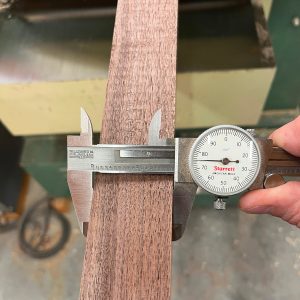
You need some good tools to let you know. One of my great leaps forward as a woodworker was a commitment to good measuring and layout tools. Some are inexpensive and some seem pricey at first. Let’s look at the inexpensive first. A good steel ruler is essential. It will get you close, most of the time. If you want to be sure of things, calipers will make a world of difference. Mine read in fractions because I think better in fractions and I don’t like to convert back and forth to decimals. Please don’t try to convince me that I should convert to the metric system. I’m well prepared with a long argument about how foolish and silly it is, and you won’t win.

The one tool that I rely on more than any other is a Starret 6″ combination square. Yes, it is expensive and it’s worth every penny. You need one, and if you try to work with an inexpensive substitute, you will be flushing money down the toilet. The kids can get through this school year with last year’s shoes; the soles aren’t worn completely through and their toes aren’t pinched that bad. You need the Starret square. When you shop, you’ll be tempted to get the 12″ one because it’s only about $10 more, but that’s bigger than you need. You also don’t need to buy the protractor or the center square. You will use those once to see how they work and put them in a drawer.
In addition to being a reliable square for checking things, you can use the adjustable square several ways to make layout and marking quick and easy. You can set a distance, then slide the stock along the edge of a board with your pencil on the end of the blade. Eventually you’ll want to get a 4″ double square too. Even though I like the Starret combination square, I think this one from Veritas is a little better for the 4″ double square.

You can also use that set-up to mark off repeating distances. Consistency is more important than absolute accuracy. Your 5/8″ setting may really be .629″ instead of .625″ but if it’s the same throughout your project things will fit. You always hear pithy advice like “measure twice” and “double check your work”, and I’m not going to argue against that. But I need to warn you that if you use the same instrument and the same method when you measure twice, the chances are good that if you’ve made a mistake you will repeat it.

Here I’m checking the line I made with the square by using the steel rule. I have the 1″ mark over the edge because that is easier to see than using the end of the rule. In the opening photo, I’m using a block of wood against the end of the board to register the end of the rule. I used to try to feel the end of the rule with my finger until I realized that my finger is a little too squishy to be precise.
As Chuck Bender pointed out in a comment on the earlier post, woodworking is mostly about problem solving. The curved parts of the block present some problems. The drawing gives the information you need to find the centers to draw the curves with the compass, but you still have to find them. The arched cutout in the long side is out in space, so I had to find the point where the centerline meets the edge of the curve, and extend the centerline to a piece of scrap to swing the arc. The radius on the corner is also a bit of a trick, how would you find the center?

I’ve done all this in pencil, and before I start cutting, I’ll go over most of my marks with a knife or a wheel cutting gauge. That will help locate and guide the cutting tools. You may be asking why I did all this work with a pencil, only to repeat it later on. The answer is in the last photo, the outline of my first attempt at drawing the arched cutout. I let my mind wander, concentrated on getting a good photo instead of getting the work just so. I caught the mistake after stepping away for a while, and comparing my finished layout to the drawing. And that is the most important lesson in all of this; take a good long look before you start cutting.

Leave a comment if you have any questions, or if you would like to share the methods you use for more accurate layout. Or you can tell me I’m nuts, it’s only wood, and you don’t need to be this picky. You can also tell me I’m a complete slob and a hack. I’m somewhere in between.
Do you want to catch up on all the handplane stuff I skipped over? My boss is really smart, and wrote a great book called Handplane Essentials. (Yes it’s time for my semi-annual review)
Everybody else is buying Exercises in Woodworking from our store. It’s a great way to learn (or relearn) essential skills.
My new book, Woodworker’s Guide to Google SketchUp will show you how to make mistakes on your computer, before you get to the shop.