We may receive a commission when you use our affiliate links. However, this does not impact our recommendations.

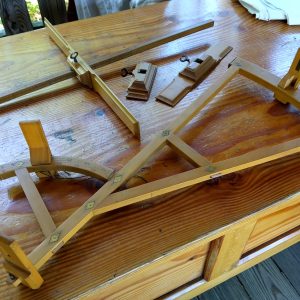
Highboys are magnificent pieces of furniture. This one is not the highboy I discuss below.
I’ll probably get pushback for this post, but I’m posting it anyway.
Three decades ago I had a unique opportunity of being considered for a conservator’s position in the magnificent furniture collection at the Winterthur Museum and Gardens in Wilmington, Delaware. How that came about is another story. Here, I want to relate some of what I came to believe after touring the museum during the interview. (If you ever get the opportunity to tour this museum, don’t pass it up.)
Conservators are tasked with preserving our heritage: buildings, paintings, textiles, furniture, etc. My impression is that there are two large categories of conservators, those who work in museums and those who work for private individuals and companies. These conservators are called “Conservators in Private Practice.” In fact, they have their own sub-group within the conservator’s organization: American Institute for Conservation of Historic & Artistic Works (AIC).
Museum conservators practice a much purer philosophy of minimal “intrusion” and trying to preserve everything original than conservators in private practice who are usually required to make the objects functional. A chair in a museum sits behind a rope and isn’t touched by visitors while a chair in someone’s house is usually sat upon and needs to hold up to this.
The object in the museum that stands out most in my memory is a highboy (not the one pictured). All its joints were lose and it would have fallen apart if not for an elaborate frame that was built for it and attached to its backside. I looked at this piece and really wanted to reglue it so it would be functional.
I mentioned doing repairs like this during my interview and was soundly scolded. This was not something that was even considered at Winterthur. Instead, everything was left as close to the existing condition as possible, and records were kept of everything that actually was done to each piece and filed in a file cabinet. These records would tell future conservators what had been done to the furniture in the collection.
The conflict I had in my interview probably played a role in my not being hired, an outcome for which I have been forever grateful because the position was very prestigious and would have been hard to turn down. I was very happy in my restoration shop regluing loose furniture and replacing parts.
Anyway, this highboy and the record keeping got me thinking. Which is likely to survive longer, a highboy in functional condition or paper records in a file cabinet? As long as the economy flourishes (so Winterthur survives) and as long as catastrophes are avoided (war or environmental, for example), both would probably survive for the foreseeable future.
But, what if something happens that causes the collection fall into the hands of people struggling to survive? Which would be more valuable to them: a file cabinet of records, or a functional highboy (chest-of-drawers)?
I would have reglued the highboy (with hide glue, of course).
Your thoughts can be entered in the box below.
– Bob Flexner
Here are some supplies and tools we find essential in our everyday work around the shop. We may receive a commission from sales referred by our links; however, we have carefully selected these products for their usefulness and quality.