We may receive a commission when you use our affiliate links. However, this does not impact our recommendations.
My favorite drafting instructor in design school was a histrionic misfit known as Wild Bill. He didn’t pull any punches and tried his best to prepare us for the real world. When we came to descriptive geometry, he let us know that by the end of the quarter at least a third of us would no longer be design majors; we’d have to switch to photography or fine arts if we didn’t get it. His favorite dramatic device when he caught someone making a mistake was to refer to a scene in Repo Man. “Smoking boots!” he would shout, “you’re nothing but a pair of smoking boots!”
It’s a powerful image, and there have been many times in the years since when what seemed like a good plan somehow went horribly wrong. One of the differences between woodworking and science fiction is that there can be a significant time lag between “Give me the keys” and vaporization of everything except your Red Wings. If you read the Woodworking magazine weblog, you’re probably familiar with the saga of the Chinese stool that has been going on since last spring.

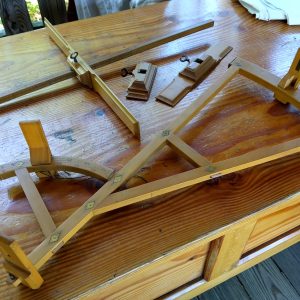
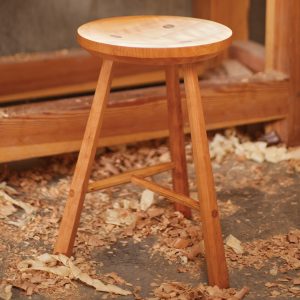
The stool looks simple enough, and in many ways it is; three legs connected by three stretchers support a round seat. We have an antique example that we dissected with a dead blow hammer, and the construction isn’t quite as simple as it seems. The center of the stretcher assembly is the center of the triangle between them and that causes the stretchers to twist a few degrees where they meet the legs. It’s a fun project because you can’t rely on any of the usual things you use for reference. Nothing is square, the only things certain are an imaginary plumb line through the center and an imaginary circle about 9 inches off the ground.

You can’t hold one part against another to get a length until all the joints are cut. But you have to know the length to cut the joints. Like the stretcher to leg joint, I’m a little twisted and I think figuring out how to do stuff like this is fun. I came up with a plan and made one stool to be sure I had the procedure down. It was a little sloppier than I wanted it to be, but it went together and it’s a marvelous piece of engineering work. There needs to be some wiggle room for it all to fit together, but there’s a point where all the parts interlock into a strong structure.
I started in on the second stool, shooting photos as I went for the upcoming magazine article. And in the midst of it, I made a fatal error. Instead of transferring a layout mark from the bottom of the assembled stretchers to the top, I flipped the assembly over. Three angled through mortises and three compound angled tenons later I tried to dry fit the stool. Like all great bonehead moves it took a while to figure out what was wrong. The stretchers fit together nicely. The legs fit into the seat, and the ends of the stretchers fit the legs. Six of the seven parts would fit, but there isn’t a hammer big enough in Ohio or China to make the whole thing fit together.

This also happened at the classic time to discover a mistake, Friday afternoon. At two o’clock I was telling myself I’d have the stool together by 3:30 or 4 and I’d get home early. At five o’clock I realized something wasn’t right and at quarter to six I knew what it was and headed for home in disgust. The only solution was to remake all the stretchers. At least I’d only ruined the smallest parts this time, not the seat or the legs.
Remaking the stretchers when I got back to work on Tuesday wasn’t anywhere near as bad as I thought it would be over the weekend. They say that if you learn something by reading it or hearing it you need to have it repeated six or seven times for it to sink in, but the things you learn by making a mistake stick with you right away. In woodworking there is always something new to be learned.
I know that you, the reader never do things like this, but perhaps you have a good goof up story about a friend, neighbor or coworker. You can share it by leaving a comment.
Here are some supplies and tools we find essential in our everyday work around the shop. We may receive a commission from sales referred by our links; however, we have carefully selected these products for their usefulness and quality.