We may receive a commission when you use our affiliate links. However, this does not impact our recommendations.

I suspect this will ruffle a few feathers, but so be it.
I’ve been asked a lot lately if one really needs a jack and a jointer plane. Several well-respected woodworkers and writers now teach that you can prepare all your stock for finishing with only one bench plane, a smoothing plane, if you use machine-prepared stock.
I suppose that’s true in the same way that I could write all my blog entries with a manual typewriter, scan them and then use optical character recognition to prepare them for the Internet. Yes, you can do it, but you will get a lot more done if you use the tool that was designed for what you are trying to accomplish.
Like most woodworkers, I use machines to prepare my rough stock, but then my hand tools take over to get things flatter than the machine can (thank you, jointer plane), cut the joinery and prepare things for finishing.
That short statement is nice and tidy, but it really doesn’t help you, does it? The more helpful explanation is messier and longer. Sorry. But learning patience and complexity is an important part of the craft you signed up for.
So first let’s discuss the much-maligned jointer/try plane – the longest plane in the shop.

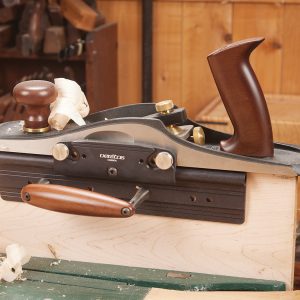
A jointer plane
Jointer (aka Try) Planes
Let’s say I asked you to build me new kitchen cabinets (and fulfill my wife’s wildest fantasy). But I said you could use only a 6” ruler for marking and measuring. You could do it. And if you were really good, you’d probably manage just fine. But it wouldn’t be easy, especially when you were dealing with any measurement more than 6”.
The same idea is true with handplanes. You could use a 9”-long smoothing plane to true an 8’-long edge. But it takes a lot of skill and attention. But when you switch to a 24”-long try or jointer plane, then it becomes child’s play. The long sole virtually guarantees a high level of accuracy.
I find that any handplane can easily straighten a surface that is twice the length of its sole. A 9”-long plane is good for wood that is 18” long. A 24”-long plane is good for wood that is 48” long – and 48”-long boards are typical in furniture-making.
Like your straightedge, your jointer plane is your guarantee that a surface is flat. The difference is that the jointer plane can make a surface flatter. A straightedge is impotent at this task.
When I talk to people who use only a smoothing plane (which is the least-used plane in my shop) I imagine they build only small things. It helps me sleep at night.

A jack plane
The Jack Plane
I am deeply suspicious of anyone who won’t spend $20 to own a jack plane that can last them the rest of their lives. Armed with an iron that has a curved cutting edge (an 8” or 10” radius is typical), you can achieve superhuman feats with your jack.
Need to remove 1/4” of wood on one area of a board’s edge? The jack plane will laugh at that task, where an electric jointer or smoothing plane would struggle. The jack literally eats wood for breakfast (and lunch and dinner, elevensies, supper, snack-time, and etc.).
You don’t have to be strong to wield it. The curved iron (and working across the grain) makes it an easy tool to use.
I use my jack plane more than any other plane in my chest.
Example: Say I need to bevel the underside of a tabletop. I could do that with a smoothing plane. But a jack will waste away the wood in seconds. The smoothing plane can clean things up later and take the glory.
Need to remove twist from a rough board? The jack (worked diagonally across two high spots) will make things true before your smoothing plane can even get started. Need to waste wood away for a moulding? For a saddled seat? For bevels or chamfers of any angle? To fit a moulding against an irregular plastered wall? Jack is your friend. It doesn’t need a flat sole, a fancy iron or cap iron. Just a sharp and curved cutting edge will do the job.
Not My Idea
Using three planes – jointer, jack and smoother – is an idea that is as old as Western woodworking. Even when machines began taking over the grunt work, woodworkers of all stripes found that these three planes made their workshop lives a lot easier.
That’s why you’ll find so many used jack and jointer planes that are metallic. Think about it: When Stanley started cranking out millions of planes using automated machinery, that same automated machinery had made it easy to process rough timber into flat boards.
Yet even then, jack and jointer planes were still essential. Even in shops where machinery did the donkey work.
I think that’s worth thinking about.
— Christopher Schwarz
Here are some supplies and tools we find essential in our everyday work around the shop. We may receive a commission from sales referred by our links; however, we have carefully selected these products for their usefulness and quality.