We may receive a commission when you use our affiliate links. However, this does not impact our recommendations.

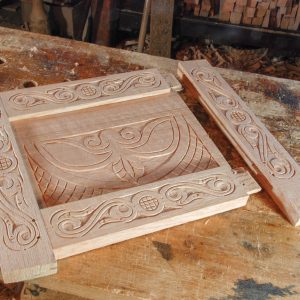
The cover story for the April 2016 issue (#224) is Caleb James’s article on making matched sets of Roubo-style moulding planes (the three sizes for which he reaches the most: Nos. 4, 6 and 8). To whet your appetite (and so I can show off the gorgeous opening image shot by Daniel Dubois, whom you really ought to follow on Instagram), below is a preview: a “sidebar” Caleb wrote about how to heat treat O1 steel using a simple setup and one clever jig (that is not a click-bait line – promise).
The issue mails to subscribers in mid-February, and will be on newsstands at the beginning of March.
Heat Treating O1 Steel

A firebrick enclosure helps to evenly distribute heat on the tool steel.
Heat treating O1 tool steel is simple. In short, bring it to critical temperature, quench it in vegetable oil, then temper it in an toaster oven or regular kitchen oven for one hour at 400˚.
Hardening steel is the easy part; minimizing warpage is another. The road to success is to evenly heat the metal. Creating an enclosure with something such as fire brick will help you achieve this.
Heat the steel slowly using a simple MAPP gas torch. Heat more slowly than you think. If one side is hotter than the other when you quench it in the oil it will warp. So heat slowly.
There are a few methods to determine when you have reached critical temperature. Avoid relying on color because ambient light will affect the color you see. Just like a flashlight appears brighter at night than in daylight, so too color alone in changing light conditions can be deceptive. The simplest way to check that you have reached critical temperature is to use a magnet, because O1 tool steel loses its magnetism at approximately this temperature. The stick of maple shown above has a rare-earth magnet glued to the end; it’s a simple tool for safely checking the steel as it reaches critical temperature. Just periodically remove the steel briefly from the flame and check with the magnet.
Another option is to watch the surface quality of the steel. It will change when critical temperature is reached because the carbon begins to flow within the steel and some decarburization takes place at the surface, thus changing how it looks. It can be described as the steel “sweating” or having a “flushed” appearance. Accompanying this change will be a noticeable uptick in the “brilliance” of the steel. In other words, rather than seeing a particular color change you would simply see the color become more radiant.
Once critical temperature is reached, quench the steel in oil by plunging the blade straight down vertically, not leaning to one side or the other. Now immediately move to your oven to temper for one hour at 400˚. — Caleb James
Here are some supplies and tools we find essential in our everyday work around the shop. We may receive a commission from sales referred by our links; however, we have carefully selected these products for their usefulness and quality.