
Making woodworking tools doesn’t interest me as much as making furniture, but my recent encounter with Henry O. Studley’s tool chest has me eyeing the metals section of the McMaster-Carr web site.
The tool that turned my head is small and simple, but boy do I have a crush on it.
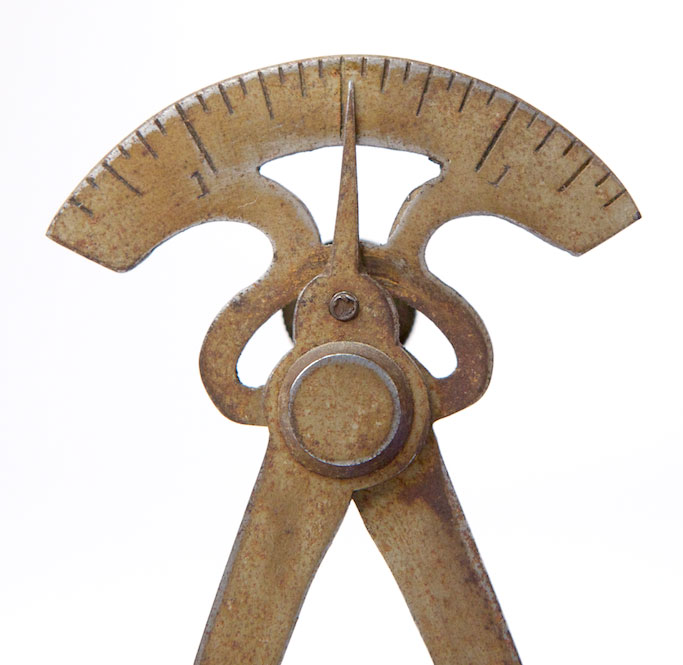
It’s a locking thickness caliper that looks to be made of brass or brass-plated steel. Studley had it mounted in the top left section of the right shell of his chest. It was in the front layer of tools and easy to remove, so I suppose it was used frequently.
I’ve never seen a caliper such as this, and I wonder if he made it himself. There are no maker’s marks on it. If you’ve seen this tool before, let me know. (Maybe we can get it printed on the side of a milk carton. “Have you seen this tool?”)
What I really like about this caliper is that it is ideally suited for handplaning, especially thicknessing boards. You can set the caliper to the finished thickness you require and lock the caliper to that setting. Then you can test your board with the caliper as you work. It works much like a mullet when checking thicknesses of raised panels, but this mullet is adjustable.
The rounded tips of the caliper are one of its nice features. I’ve tried using locking dial calipers to check my thickness as I work and they are difficult to use like this because of the shape of the jaws. Try it, and I think you’ll agree.
Studley’s caliper is made of two plates of .060”-thick metal (probably brass). Its overall length is 3”; its maximum width is 1-11/16”. The locking nut on the back has a 7/16” diameter. The scale at the top of the caliper opens to 1-3/4”.
When I first looked at the chest, my eye was drawn to the infilled mallet in the top right of the cabinet. That one is similar to mallets that I own, but Studley’s mallet (naturally) has a lot more class and detail.
But after examining every one of the tools in his chest, cataloging each one for Don Williams’s forthcoming book on Studley and putting all the tools back in place, it is the caliper that sticks in my memory as the one I wish I could have stuck in my pocket (it’s shameful, I know).
Forgive me Studley, for I have sinned.
— Christopher Schwarz
If you are interested in making your own tools and appliances for handwork, then I highly recommend Jim Tolpin’s book “The New Traditional Woodworker.” This book is a great lesson in using the tools to make the objects that make your tools work even better – a straightedge, winding sticks, try square and so on.


Furtherchecking reveals that the item is a Kraeuyer #3 cast steel with set screw, nickel plated register caliper. Came in 3′($.65)4″($.75),5″ ($.90),6″($1.00) sizes.
Too bad no chance for a picture. I have one. Mine looks to be identical. Mine has initials on it LFL. No other markings. Lighter in weight than most tools of the time. Doing basic research WFLP(?) WARD made one similar as shown in Salaman’s dictionary. Sellens book shows an illustration of what we have as a caliper, self registering, or register caliper. Ours appears to be a Kraeuter Company, Newark NJ. Formed in 1879. It is shown in catalog of 1891 and perhaps in the 1911. Cope says that the calipers were made by Wm. Johnson. Did I do Good?
You got to pull all of the tools out of the Studley tool chest!?!
you suck!
Chris, The fact that this tool has a “zero-center” scale suggests to me that it probably is for both inside and outside measurements, such as mortice and tenon. If the tips are offset (hard to tell in the photo) then you could squeeze the bows together so that the tips would cross each other and engage the sides of an open gap.
I might try to build one of these.
Keep up the good work.
Steve Haskell
Hi Chris and all…new to the blog (and woodworking for that matter
and looking forward to learning more here! In reference to the Register Caliper, I found something that is similar and maybe of interest at MSCDirect.com…although this does not have a gage, the OD measurement tool can be locked. Here’s a link, which is on page 1467 of MSC’s catalog and there is more on page 1468 http://www1.mscdirect.com/cgi/NNPDFF?PMPAGE=1457&PMITEM=62393863&PMCTLG=00
I think this is the modern version:
http://cdn.eagleamerica.com/images/popup/400-2041_p.jpg
I have one of these that I use with my thickness planer. I machined a small brass pin to fit the holes on the scale end to lock it at 1/4″ increments. I use it like a go/no-go gage when thickness planing stock.
-Brian
Is this the modern version?
http://www.leevalley.com/US/wood/page.aspx?p=66818&cat=1,43513,43550
There were two or three of these gauges in the locker when i was in woodshop in high school. That was from 1959-62. They looked old and used then. Don’t know how old they were.
Chris–Just a suggestion. Add a small magnet to your list of stuff to take the next time you go on a mission like this. It’ll settle the brass/steel question.
Chris, can you share a picture of the back of the tool please? I’m interested in seeing the back of the pivot and the locking screw.
Joe
Yup, he wins it! I was looking in the Montgomery catalog. Nice job!
The tool is called a Register Caliper, and is shown in the 1890′s Chas. A. Strelinger & Company catalogs:
http://books.google.com/books?id=TAfiAAAAMAAJ&dq=%22register%20caliper%22&pg=PA10#v=onepage&q&f=false
Yup. Jeff wins the prize!
Here’s a cropped shot of the tool.
http://www.popularwoodworking.com/wp-content/uploads/register_caliper.jpg
I bought one on ebay several years ago (more than 4 or 5), and didn’t pay that much for it. The only difference I see is on the pivot nut/rivet – slightly different. Mine is plain steel, no finish or plating. Also no makers mark on it at all.
Hmm… maybe not watchmaker. I know I have it in a catalog, I just have to find the catalog!
Looking at the scale it seems the caliper can be used as an outside and -to some extent- as an inside caliper(?)
Alfred
Not as vintage looking but isn’t the lock joint caliper from Starrett functionally the same?
http://www.starrett.com/metrology/product-detail?k=36-6
Kinda. But there is no scale. I think that Studley had one of these, too.
It’s a watchmakers thickness caliper.
Chris,
I acquired at tool like the one above some years ago. At first glance, it appears identical to the one I have, although the pointer is different, and it’s made of steel, not brass. Mine doesn’t have a maker’s mark either.
Outside calipers work better for me when thicknessing boards. Fractional calipers are fine for checking tenons, but a little delicate for full size stock, in my very humble opinion.
Chris,
I’ve been reading your columns and books long enough that I feel like I should already know this word. But… what’s a mullet? I assume it’s some type of gauge for checking the thickness of a raised panel, and you’re not talking about Billy Ray Cyrus’ haircut. But I’ve never heard this term used in wooodworking.
Thanks,
Mark
Mark,
I wrote about mullets in “The Joiner & Cabinet Maker,” but I have’t covered them here on the blog.
Here’s a photo of one in use:
http://www.popularwoodworking.com/wp-content/uploads/mullet_IMG_7337.jpg
They are thickness gauges – typically used to determine if your raised panel is feathered correctly.
Hope this helps.
I was going to ask the same thing (and had the vision of sticking Cyrus’s head against a raised panel but feared the gel would alter the color). Thanks for answering the question and saving me from tonights nightmare!
Hi Chris,
Is “The Joiner & Cabinet Maker” a book or an article you wrote? I tried searching for it but didn’t get any relavent hits. By the way, I just finished The Anarchist’s Tool Chest and thoroughly enjoyed it. Thanks.
Jim
Book.
http://www.leevalley.com/en/wood/page.aspx?p=64629&cat=1,46096,46132