Chris Schwarz's Blog

More Campaign Furniture Pieces to Explore

FavoriteLoadingAdd to favorites

I’m in Charleston, S.C., this week to fatten myself up on grits and explore some of the antique shops for campaign furniture examples to study.

First the bad news: Antiques of the Indies, the awesome King Street shop I visited last fall, recently closed. However I found that the owner had taken a booth at Seventeen South Antiques, a shop across the river. And after poking around some other King Street shops, I found some other interesting pieces to study.

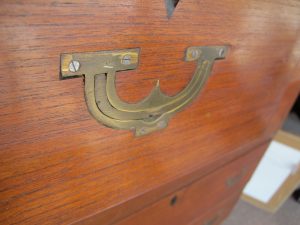
The best find of the day was one of the prettiest campaign chests I’ve yet encountered. This circa 1840 chest had fantastic skeletonized hardware and lots of hallmarks of a well-made piece: dust seals between the layers, central muntins on the drawer bottoms and drawer slips.

The great thing about doing research at a store is they (usually) let you take the whole thing apart – as long as you are gentle.

The other fun find of the day were some Anglo-Indian perfume boxes. These little brass-bound boxes have metal chasing in the lid. The insides can be simple or have elaborate metalwork, which sometimes is used to hold in a mirror inside the lid.

I also photographed a mahogany lift-lid chest with some nice corner brasses and a central pull – a common feature. This chest had a till at the end.

OK, enough talk about furniture. There’s a bone marrow bread pudding calling my name.

— Christopher Schwarz

Want to read other stories I’ve written about campaign furniture? You can access all of them here for free.  Or if you want to see and build the campaign chest I made for our July issue, click here to subscribe.

Christopher Schwarz

About Christopher Schwarz

Chris is a contributing editor to Popular Woodworking Magazine and the publisher at Lost Art Press. He's a hand-tool enthusiast (though he uses power tools, too).

Related Posts:

RSSComments (18)

Leave a Reply | Trackback URL

  1. Glad to see some interest in this neglected style. I have made a couple of these pieces over the years, the originals are quite expensive. I love the simple yet elegant feel to them.

  2. Fatten you up ?!
    Man, that’s going to take a LOT of grits !
    Hell, I eat sandwiches as thick as you.

    And I can see trying one of those cool shaving boxes some where down the road.

    Thanks Chris.
    Hope you enjoy your “research trip”…lol…

    • Joel,

      Been coming to Charleston for 22 years — my dad lives here on the peninsula. I’ve eaten enough fried green tomatoes to fill a grain silo. She crab soup. &c.

  3. On small boxes, do the brass fittings substitute for dovetails or other joinery? They seem to be constructed so the brasses hold the box itself together. Or am I just not seeing the actual joinery?

    The chest with the till is interesting. The presence of the till, which is similar to so many early American chests, makes me wonder if one of the primary purposes was to have a lid on the till to flip open, which would in turn keep the lid on the chest from crashing down. Or am I ascribing an unintended purpose?

    • The small boxes had corner joinery — the brass was just there to add some panache and reinforcement.

      On the till in the floor chest — it would hold the lid up about 1″ from the carcase — so it didn’t work like a blanket chest.

  4. Hard time telling what I’m seeing – can’t tell if that’s translucency or a line of dust/paint/whatever – is that dust panel (in the fourth shot down on the left hand side) made of fabric?

Leave a Reply