
• Free Woodworking Advice And a Free Project: Handplane Birdhouse

    Newsletter signup includes free plans, e-mails with coupons from our store, and new product releases from woodworking manufacturers.

  • Secret to planing end grain?

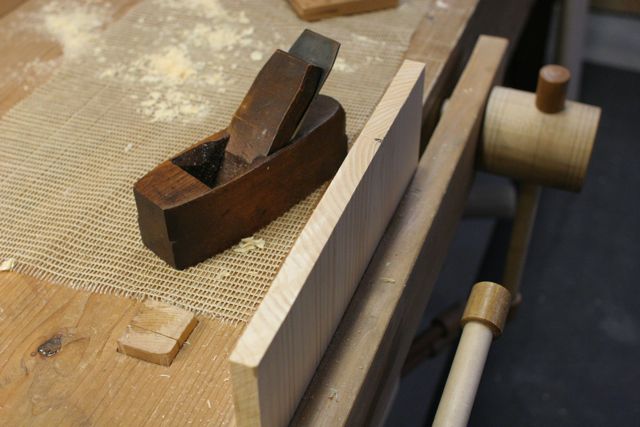
    Is there a secret to planing end grain? Is a low-angle block plane required? I don’t think so. My trusty wooden smoother does a good enough job for me. What you need to plane end grain is a SHARP plane. If that’s your block plane, use that.

    If I had to come up with a secret I’d say I prefer to plane end grain with a plane that has a cambered iron. That way I can square up a hand-sawn end the same way you square an edge with a try plane.

    — Adam Cherubini

    Adam Cherubini About the Author: Adam Cherubini is a long-time woodworker and contributor to Popular Woodworking Magazine, who studies and works in the 18th-century style using period techniques and tools.

    Related Posts:

    • No Related Posts Found

    RSSComments (11)

    Leave a Reply | Trackback URL

    1. tconover@fuse.net says:

      I am 66 and very new to woodworking and I am donig my best to soak in as much information as I can.
      I have purcheshed three very good planes (lie nielsen), a #4 smoother a # 5 ½ fore and a #7 jioner.
      I have built two projects so far (a bench hook and a sawbench (Christopher Schwarz design) and want to build my workbench next.
      I am puzzled about end grain. Even on my two “small” projects I had a problem with small pieces of the wood tearing out from the edges.
      I have a hand plane book on order from “Woodworking” which I hope will answer this and many other questions I have.
      Also are there any good woodworking classes in the Cincinnati Area.

      • Galoot says:

        Try using a knife to scribe around all four sides of the end. If you already do that, try scribing a little deeper. The wood at the edges won’t tear out because the fibres have already been cut.

        If you’re getting spelching at the short ends, try starting at one end and planing toward the middle. Then do the same from the other side.

    2. C.Woodhouse says:

      Wouldn’t a steeper grind help?

      • Adam Cherubini Adam Cherubini says:

        Conventional wisdom says steeper grinds hinder our efforts planing end grain. The belief seems to be that only a low angle plane can handle end grain. Clearly that statement is flawed. I can easily plane pine end grain (pine’s end grain is particularly difficult to plane) with a smoothing plane.

        My view is simply that any sharp plane will do okay. Smoothers offer advantanges only in that they are easy to handle on what is typically a short and narrow surface.

    3. zdillinger says:

      You’re a lucky man, Caleb. I’d love to own an Old Street plane.

    4. GunnyGene says:

      This leads us to the question of how sharp is sharp? I usually get them to the stage where I can shave the hair off my chiny-chine-chine (which looks a little odd for a few days), but still have difficulty with endgrain on various hardwoods even tho I do employ the recommended techniques, etc. that have already been mentioned.

      Instead of a brute force frontal assault, it seems to me that a new plane design might be in order which takes into account the physics of the problem. What’s needed is a slicing or sawing action. Any ideas?

      • Adam Cherubini Adam Cherubini says:

        Hey Gunny,

        My view is that a new or special purpose design is NOT required. All that’s needed is a REALLY sharp plane. In the hand plane design world, I think sharp trumps all.

        Just my 2 cents

    5. wmickley says:

      I use a plane bedded at 42 1/2 degrees for end grain. I can see and feel a small improvement over 45 degrees. Likewise I think 45 leaves a better surface than 50. A fine surface is helpful for finishing because it takes less finish material to get a good surface; less coats are necessary.

    6. Jalatham says:

      Absolutely right. As for me , I don’t even own a smoother yet but use my 28″ jointer w/ a 50 degree bedded iron because thats what I have. You know what? It works great! (When it’s sharp.)

    7. My experience too. I’ve not found a low angle plane necessary at all. My regular smoother works just fine. In fact, I find that I very rarely even use a shooting board these days, unless a piece is very narrow. As you say, though, the plane does need to be very sharp. I find it helpful to have my knife scribe on all four sides as well in order to have a gauge to plane to when squaring up the cut. I also plane from both edges toward the center.

    8. wanderer says:

      Thank you for the tip. I will give it a try with my beautiful new little Old Street smoother.

      Caleb

    Leave a Reply

    You must be logged in to post a comment.